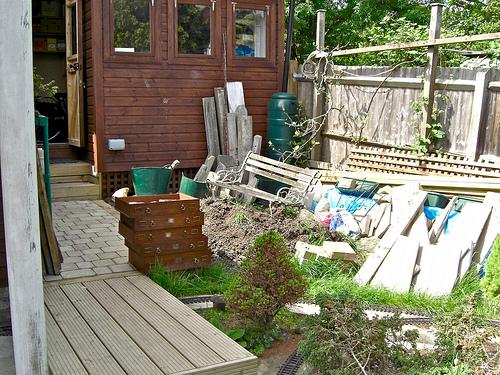
Showing posts with label sheds. Show all posts

Tuesday, June 3, 2014

Build a Proper Shed, from the Outset

Photo credit: Christine (flickr.com)

Only neat freaks avoid clutter from piling up, and you're probably well-acquainted with the piles of knickknacks on your garage or basement. You can get away with clutter if it's tucked away in a forgotten corner in your home, but you have to admit your well-worn and used tools need space to call their home. That being said, there's a concern handymen and homemakers have in common: the shed or at least a small alternative to it. It's the ultimate solution to problems of backyard organization, and you have to build one of your own if you want workspace and storage that's functional and easy to the eyes. Building a shed should be an invested effort, and even if you can avail of easy-assemble sheds at a home depot or online store, you still have to make sure the space is prepped and the project is properly executed.

Location Is Crucial

Your shed will be a standalone structure in your garden or backyard, so you have to choose the best spot to build it. Choose level ground found high up on a rise in your property, make sure water doesn't collect and sludge around its foundation. The right spot saves you time, costs, and effort building drainage around and away from your shed, and it's also displayed as a prominent structure on your property. Sludge rots and rusts wood and metal, even if you invest in a solid foundation. This is all the more important if you're building a shed large enough to serve as your private workspace.

Prerequisites to Building

Believe it or not, but such a small project requires the approval of a building inspector just the same. It's important that you're aware of this at the outset, be friendly with yours and make the process as smooth as possible. A building inspector should be your best friend throughout the process, reviewing the plans, checking out the site, and making sure everything complies with local building codes. You'll also get free advice if ever your shed plan doesn't meet the standard. At the very least, your inspector spares you from building a costly mistake, so consider yours a blessing in (heavy) disguise.

A Stable Foundation

Your shed's foundation makes all the difference in stability, and you can choose between solid bricks or pressure-treated timber for yours. Depending on the size of your project, the foundation should be laid along the grade. Avoid using hollow bricks as these eventually buckle under the pressure of the structure. For larger projects of at least two hundred square feet, you'll need a permanent foundation of poured concrete. Consider shed building advice you can find online if you’re up for something more elaborate. You'll have to dig deep for the poured concrete piers and the timber posts. The specifics are more involved, though, and you can check with your local building codes for details on laying the right foundation.

Building sheds shouldn't be too troublesome if you start right it right. While it's true that the simplest shed needs no involved prep work, no red-blooded handyman will ever settle for something that's second-rate and substandard. Settle on the best design and build, whether you're doing it from scratch or choosing the convenience of easy-assemble projects.

You may also like:
How to Put Up a Garden Shed in the Backyard (videos.huffingtonpost.com)


Monday, May 5, 2014

How to Build a Farm Shed


Photo Credit: Simply Sheds

Space is something everybody needs, be it personal or otherwise. Homeowners in particular, who have the tendency to accumulate more stuff than they could possibly need, always seem to need storage space and when they run out of rooms to stash their memorabilia in, the next thing they turn to are sheds.

Sheds as you know, are that single-storey structures you can buy as prefabricated kits or can build with your own two hands, provided you have enough construction know-how. Sheds used to be built just for that purpose but these days, sheds can also double as home offices, art studios, play rooms, cabanas, etc. One thing that hasn’t changed is why we need sheds and why they are still the perfect solution to any space dilemma.

In addition to memorabilia, garden tools and equipment also take up a lot of room and this is why people often consider building garden or want to learn about farm sheds mainly because it suits their needs. With the option of buying these sheds pre-made, it has become even easier to decide on getting one primarily because it also suits their budget and there is no need to apply for any building permits as long as you are sure it adheres to local building codes.

To start building your farm shed, you need to decide whether you really need the additional space or if you can make do with what you have at present. Make sure you also adhere to your local construction laws or codes concerning large sheds as there are farm building and structures specifications in place so that you can make the most out of your farm sheds. Next, measure the space you want to erect your farm shed in for length, width and height and decide whether you want it connected to the main home or as a stand-alone structure. Most people find it easier to have their sheds connected to the main home for easy access.

Plan your floors based on what you will be housing inside the shed – if you are planning to park your riding lawnmowers, huge leaf blowers and other heavy-duty equipment, then a framed floor with joists and ¾ inch plywood is a safe bet. The last thing you need to decide on is foundation – you can use cement foundation which is the cheapest option or a dug-post foundation.

The next step is to build your foundation. You can start either by using short posts to connect to your joists and concrete blocks that will raise your shed from the ground or you can dig post holes into the ground and attach the joists to the outside of the post frame, bearing in mind that your joists should be at least 16 inches apart. Once they are laid, you can either lay a plywood floor or decking material over the floor and while both are suitable, plywood is recommended due to its strength.

Building a skeleton of the structure will make the body of your shed more stable. A 2x4 or a 2x6 inch construction is suitable for a farm shed project and you can start by laying two boards horizontally parallel to each other and then connecting them by laying two boards across them perpendicularly with measurements based on how tall you want your shed to be. These boards serve as your studs and should be at least 16 inches or 24 inches apart.

If you are adding doors or windows to the structure, you need to create a header on top of the doorway or window frame to prevent them from sagging. If you are creating an entryway, leave the bottom support board attached until the walls are up. When installing the walls make sure you have bracing boards or someone to hold the walls in place until you finish connecting them to each other and to the floor.

And now it’s time to add the roof. Roofs for farm sheds can either mimic a peaked house roof or a slanted roof by making one wall taller than the rest. You should remember to construct your roof in such a way that water will run down on it but will not run into the shed. This is done by laying it from the bottom up and attaching roof felt inside to keep the inside dry.

Now for the shed skin. A 4x8 foot exterior siding that is ½ to ¾ inch thick is the cheapest option any builder can go for. You either screw or nail it onto the exterior of your structure, covering everything except the holes for the windows and doors. Wood ribbing usually seals the seams.

And last but not the least, you now need to paint or stain your farm shed according to your personal preferences and install any studs, hangers or shelving units to put your stuff and tools on.

You might also like:
Yarra Ranges Planning Notes  (yarraranges.vic.gov.au)


Tuesday, February 4, 2014

A Splashing Affair!


There exists a mysterious garden shed that no one knows what to expect. It is so mysterious that it is almost impossible to describe what it is plus the fact that I don't know anything about it. It is like The Matrix: no one can be told what The Garden Shed is. You have to see it for yourself. 


If you're like me and The Garden Shed has piqued your interest, then show up in Victoria Square in Adelaide on January 31st. Is the area too big? Fret not! The Garden Shed is only one of the many "events" in Splash Adelaide.


Perhaps you're not familiar with Splash or you're not from Adelaide, or even not from Australia. Splash is a year-long community-run series of "experiments." Think flash mobs with a little less shock and awe factor and an opportunity for onlookers to join in. More fun for everyone!

Events from Splash range from street parties cooking events, and a lot more. If you're interested in more events than just The Garden Shed, head on over to the Splash Adelaide website. By getting their Splash App, you can stay tuned for news on when and where their next urban experiment will be. 


Wednesday, January 29, 2014

Projects That Can Make Your Garden Livelier


No matter how green your garden grass is, it may still feel like a desolate wasteland due to the fact that there's a lot of things missing. Personally, I like having just grass on my backyard, but that's also partly due to the fact that I hate mowing when they get too tall. If you want to add a little more detail to your garden, you can do so. If you're planning to go DIY on everything, you can always study the basics.

Planting Trees

If you don't have a backyard tree yet, it is highly encouraged to have one. Not only are you making a little mark for the environment, it's also a source of shade a few years down the line. Depending on the type of tree that you plant, it can also serve as backyard décor.

What if There Already are Trees?

If you already have trees, then exercise your creativity. There's always the tree house for your kids. If you have two trees near each other, put up a hammock for lazy Sunday afternoon siestas. If you have a tree with a really sturdy branch, you can set up a swing set. If the tree happens to be somewhat in the middle of your garden, consider building a tree bench around it.

Patios

If you're in a hurry for some shaded area in the backyard, you can have a patio instead if you don't already have one. Patios can be simple tented pavilions. At its simplest, it's even just tables and chairs in an elevated area in the backyard. You can build one yourself or you can find DIY patio kits online.

Pathways

Perhaps you're still waiting for your grass to grow or you just feel like the ground lacks a little design. Pathways are the best ways to add that extra layer of beauty to your garden or backyard. It's as simple as laying down wooden planks one after another to create a "road." If you want to create a pathway on non-grassy areas, you can start by laying down pebbles or small stones as foundation and then placing slabs of stones.

Sheds

With all the beautification you're doing for your garden, it would make sense that you have a shed to store your tools so they don't just lie around randomly on your backyard and ruining the scenery. When building your sheds, there are a few basic things that you should know.

You might also like:


Sunday, January 26, 2014

The Basics of Building Wooden Garden Sheds

Image Credit: Jeremy Levine (flickr.com)
As per my intro, I'll be presenting a few tips and tricks related to DIY and home improvement. I'll start with the backyard, specifically in building a garden shed.

If you think you can build a shed straight up, think again. Building a shed requires equal amounts of planning and labor. Nothing is more frustrating that building a shed and realizing that it is not what it's supposed to be. Wooden sheds, in a particular, are susceptible to accelerated decay if you just erect one without considering where you place them. It doesn't even matter how good your timber is, you have to plan your shed construction before you start the actual construction.

In fact, there's a lot of things to think about.

Legal Stuff

Before you can even begin construction, you will want to know your city's building codes. Each city or state has its own rules, requirements, and criteria. For instance, Seattle allows no-permit constructions of sheds if criteria are met. Some cities will not require a permit for a small garden shed, but you will still need to abide by your city's building codes. To be sure, contact your local council.

Purpose

Determining the purpose of your wooden shed is important if you want to save a little money. For example, a purely storage shed need not be pleasant to look at and will thus not require an abundance of materials. If you're going for a more decorative shed, creative paint jobs will be far cheaper than using more timber to add aesthetics.
Location

The location of your shed should also be taken into consideration, and not just where it looks the best. Strategic location of your shed is important for its longevity. If you're building a shed on a slope, for instance, facing the door with the higher end is more convenient when entering the shed. Putting your shed on high ground ensures that it doesn't collect rainwater during downpours.

Base

If you're going to put your shed on a concrete area of your garden, then there's not much to worry about as the concrete can be your base. Otherwise, you'll need to think about putting a base for it. The bottom parts of the shed's walls are often the first to break down. To preserve them, avoid having them touch the ground. A steel or brick base should be enough.
Once you've considered these basics, you can then start planning how to create your garden shed. There are a lot of free plans you can get online or even watch tutorial videos. If you think it's too much work, you can always purchase wooden garden sheds online.

You might also like:

A guide to indoor gardening (edition.cnn.com)